
IBIT vs. Bitcoin: Costs and Risks US Investors Should Compare
The short answer: IBIT provides Bitcoin price exposure through an exchange-traded security; buying Bitcoin directly involves a different set of ownership and custody choices. The comparison should include recurring charges, trading costs, transferability, and responsibility for access. A low quoted trading fee is not the full comparison, and neither route removes Bitcoin price risk.
First decide what you want to own
An IBIT shareholder owns shares in the trust, rather than Bitcoin in a personal wallet. A direct buyer may leave coins with a custodial provider or move them into a wallet they control, subject to the provider's terms and supported transfers. Buying directly is not automatically the same as taking self-custody.
Fidelity's overview of ways to invest in crypto explains the distinction between direct holdings and exchange-traded exposure. For the specific IBIT product, check the issuer's current product page and prospectus.
| Question | IBIT shares | Direct Bitcoin |
|---|---|---|
| What is held in the account? | A security providing exposure through the trust | Bitcoin held through a provider or a personal wallet |
| Can the holding be used for an on-chain payment? | Retail shares are not spendable Bitcoin | Coins can be transferred when the selected custody arrangement permits |
| Who manages the private keys? | The product's custody arrangements handle the underlying assets | The provider, or the owner under self-custody |
| What trading access is available? | Depends on the exchange, broker, session, and order rules | Depends on the venue, liquidity, account access, and operational status |
| Does the route remove market loss? | No | No |
Put recurring and transaction costs on the same page
The IBIT issuer page checked for this draft lists a 0.25% annual sponsor fee. Verify the current figure before acting; product charges can change. That recurring fee is only one component of an investor's total cost.
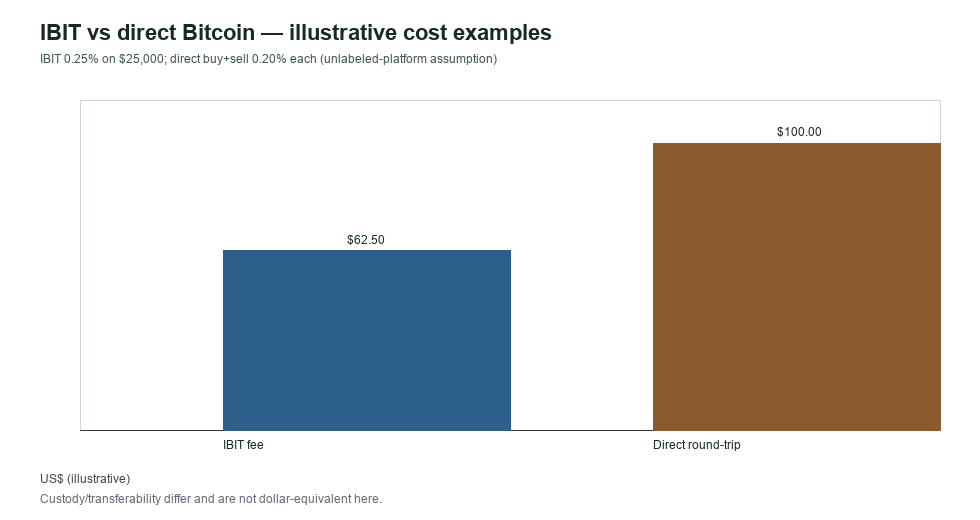
On a hypothetical $25,000 holding with a constant value, 0.25% is approximately $62.50 for one year. This simplified illustration ignores changes in asset value, fee accrual details, tracking differences, commissions, bid-ask spreads, and taxes. It is not an actual account charge statement.
A direct holding has a different cost structure. Depending on the provider and activity, relevant items can include a purchase fee, spread, sale fee, withdrawal charge, network fees, custody costs, or wallet costs. Some costs apply only when an investor trades or transfers; they should not all be treated as annual expenses.
| Cost to check | How to compare it |
|---|---|
| Recurring product or custody charge | State the annual rate and the value to which it applies |
| Purchase and sale charges | Count both sides if a round trip is being compared |
| Bid-ask spread and execution | Use a stated quote time and order size, not a generic headline price |
| Transfer or withdrawal charge | Include it only when the assumed route actually uses a transfer |
| One-time equipment or setup expense | Keep it separate from annual recurring costs |
For illustration only, a direct venue charging 0.20% on purchase and 0.20% on sale would charge $100 on a $25,000 round trip if the transaction value remained unchanged. Those are hypothetical rates, not a quote from any named exchange. The example excludes spread, transfers, taxes, and other charges.
Comparing that $100 with a single year's sponsor-fee illustration does not identify a universal winner. Holding period, transaction pattern, changing values, and the omitted costs can change the result.
Custody shifts responsibility; it does not eliminate risk
An exchange-traded holding reduces the need for the investor to handle private keys personally. The investor still needs to understand the product, brokerage access, and the product's disclosed risks.
Self-custody places key-management and recovery responsibilities on the owner. Leaving Bitcoin with a custodial venue introduces a different dependency. An access problem at a provider and a lost recovery method are different failure modes; a useful comparison names them rather than describing one route as simply “safe.”
The IBIT issuer disclosure also notes that the trust is not registered under the Investment Company Act of 1940. Do not assume every familiar fund protection applies merely because the product trades under an ETF label.
A market that moves around the clock does not give every account the same access
Bitcoin trades beyond the traditional US equity session. Whether an investor can act through a particular brokerage, crypto venue, or order type depends on that service's actual rules and availability.
Avoid blanket claims that every broker has identical hours or that a 24/7 market guarantees an executable price. For a real comparison, verify the broker's supported sessions, the venue's withdrawal conditions, and the expected costs of the intended order.
Five questions before selecting a route
- Do I want brokerage-held price exposure, or the ability to transfer and use Bitcoin?
- What are the total costs for my expected holding period and transaction pattern?
- Who is responsible for access and recovery, and what happens if that arrangement fails?
- What trading and transfer restrictions apply to this specific account?
- Does the resulting Bitcoin exposure fit the loss the overall portfolio can absorb?
Tax and account eligibility depend on the arrangement and personal circumstances. This comparison does not recommend a retirement-account strategy or provide a tax conclusion.
Discuss the trade-offs
Discuss the evidence with the CryptoSpaceX community and follow chart-based crypto updates. Read the analysis here, then join the conversation if it is useful to you.
This article is general education, not a recommendation to purchase IBIT, Bitcoin, or a particular custody service. Verify current issuer and provider terms before making a decision.
Assessment
Compare IBIT with direct Bitcoin ownership across recurring fees, trading costs, custody, transferability and access, with clearly labeled examples.
Conditions and risks
Conditions and risks: IBIT sponsor fee should be re-checked on the issuer page; direct-trade cost percentages are unlabeled-platform assumptions, not a broker quote; custody, transferability and trading hours differ by product and venue; this is not tax advice.